China’s Off Road Dirtbike industry has moved beyond low-cost production. It now includes established factories, export specialists, and engineering-focused brands. Buyers increasingly examine engine durability, suspension quality, frame design, and after-sales support. A polished showroom does not prove long-term reliability.
Industry reports from Grand View Research and IMARC Group describe off-road motorcycles as a growing segment, supported by recreational riding, racing, and expanding powersports distribution. Their market studies also highlight Asia-Pacific’s strong manufacturing role. However, these reports often combine motocross, trail, enduro, and other off-road categories. Direct comparisons can therefore become imperfect.
That matters when identifying China’s top ten manufacturers. A useful ranking should examine more than production volume. It should consider factory experience, certification practices, export history, component sourcing, dealer coverage, and warranty responsiveness. The Federation Internationale de Motocyclisme (FIM) offers technical and sporting references, while China Association of Automobile Manufacturers publications help explain domestic motorcycle production trends. Neither source alone ranks individual dirtbike factories.
Real-world evidence remains essential. A reliable manufacturer should explain its engine supplier, service intervals, parts availability, and testing process. Ask difficult questions. Inspect the welds, cable routing, air-filter access, and suspension seals. These small details often reveal manufacturing discipline.
This guide evaluates ten Chinese manufacturers through a practical, evidence-based lens. It focuses on documented capabilities, market reputation, product consistency, and buyer support. Some companies may excel in volume but lack premium refinement. Others may offer stronger engineering while serving narrower markets. The ranking is not absolute, and available public information can be uneven. That limitation deserves attention.
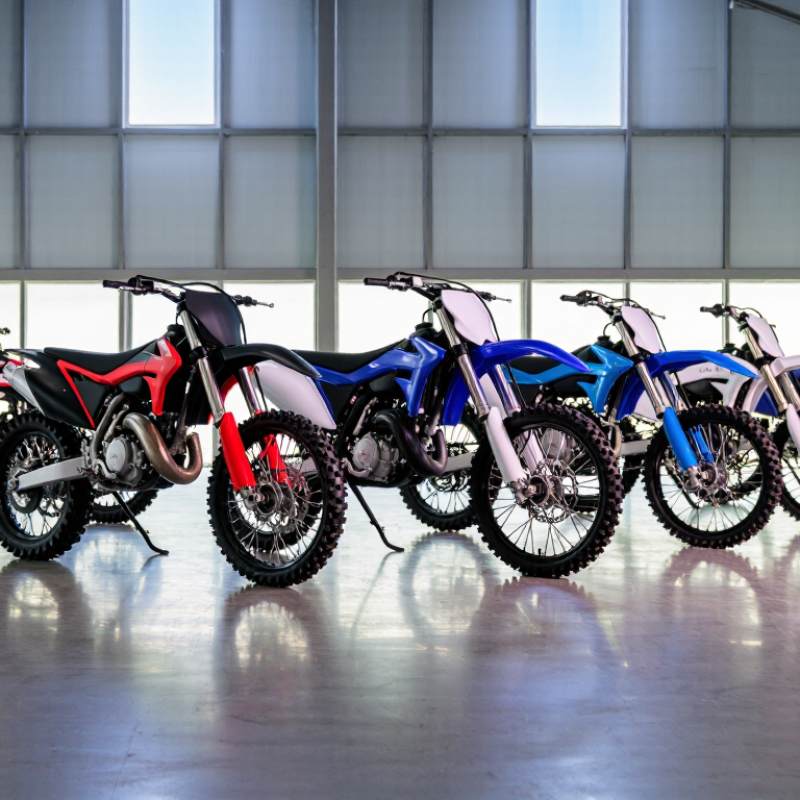
China’s top ten off-road dirtbike manufacturers should be defined by capability, not visibility alone.
An off-road dirtbike manufacturer designs, engineers, assembles, and tests motorcycles for unpaved terrain. The scope may include factories serving OEM and ODM projects, as well as producers selling their own models. It should cover engine development, frame fabrication, suspension setup, quality inspection, parts supply, and after-sales support. A trading company without production control belongs in a separate category.
A reliable evaluation examines factory experience, technical staff, production capacity, and testing procedures. Inspectors should review weld quality, brake performance, steering movement, and frame alignment. Real riding feedback also matters. Mud, loose gravel, steep trails, and repeated vibration expose weak components quickly. Export records can support credibility, but they do not prove every model performs equally. No list is perfect. Manufacturing data may change.
Tips: Request factory videos, inspection records, and sample units before ranking a supplier. Ask who produces the engine, plastics, electrical parts, and suspension components. Check whether replacement parts remain available after delivery. A useful supplier answers clearly and provides measurable specifications. Avoid judging quality from polished photographs. Visit the facility when possible. Observe the assembly line, storage conditions, testing area, and worker training. Small details matter. Feedback from experienced riders can reveal handling problems that laboratory checks miss.
A reliable manufacturer designs, assembles, tests, and supports bikes for unpaved terrain. It should control production, not merely trade finished products. Engine work, frame fabrication, suspension setup, and inspections all matter.
Check production history, technical staff, factory capacity, and testing procedures. Request inspection records and sample units. Visit the assembly line when possible.
Examine frame welds, suspension mounts, brake fittings, and steering alignment. Check chain tension and cable routing. Small defects can become expensive failures.
Test bikes on mud, loose gravel, rocky trails, and steep paths. Include repeated braking and cold starts. Vibration often reveals weak parts quickly.
Replacement parts, repair manuals, and warranty procedures affect long-term ownership. Ask how quickly common parts can be shipped. A delayed chain or brake component can stop riding for weeks.
No. Price and engine size show only part of the picture. Compare durability, braking, suspension behavior, service, and delivery reliability.
Ask who produces the engine, plastics, electrical parts, and suspension components. Request measurable specifications and test evidence. Clear answers build confidence.
No. Export records support credibility, but they do not prove equal quality across models. Manufacturing consistency can change between batches.
Some focus on beginner trail bikes or lightweight frames. Others produce enduro-style models, utility bikes, electric systems, or small-batch components. Strengths vary.
Showroom photographs can hide poor welds, weak bearings, or slow support. Some suppliers communicate well before payment, then respond slowly afterward. I may overlook issues without extended field testing.
China’s off-road motorcycle industry includes a wide range of manufacturers producing recreational, competitive, youth, and utility-focused models. This article defines the scope of Off Road Dirtbike manufacturers and explains the key criteria used to evaluate them, including engineering capability, production quality, model diversity, reliability, customization options, export experience, and after-sales support. Based on these factors, it presents a structured overview of ten leading Chinese manufacturers without focusing solely on company size or output.
The discussion also compares each manufacturer’s strengths, model focus, manufacturing approach, and market coverage. Some are better suited to entry-level riders and family recreation, while others emphasize performance, durability, lightweight handling, or professional-style applications. By considering engine characteristics, suspension systems, frame design, safety features, maintenance needs, pricing, and dealer support, buyers can make a more informed choice. The final section provides practical guidance for matching different Chinese dirtbike options with beginners, experienced riders, recreational users, and demanding off-road enthusiasts.

 Tengyue